






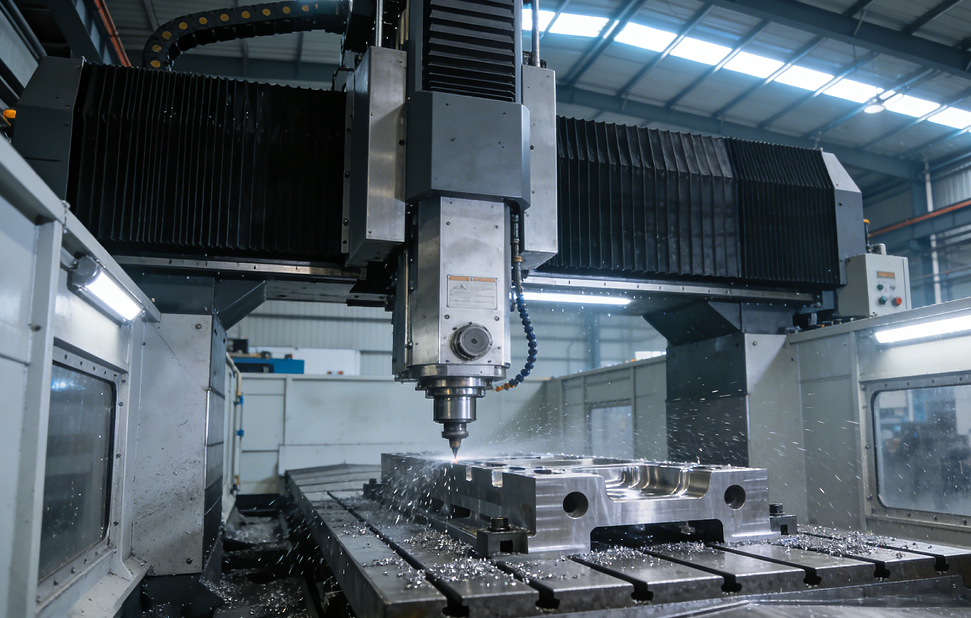
For senior procurement managers in the U.S. seeking reliable supply chains, particularly in precision component machining, understanding core technologies and selecting partners accordingly is critical. Gantry CNC machining represents the high-end capability within CNC technology, where stability and precision directly determine the quality of the final product. The following Q&A series delves into the intrinsic value of gantry machining technology and provides small-scale B2B clients with clear guidance on selecting precision CNC machining suppliers.
Question: Among the various forms of CNC machining, what is the core advantage of gantry-type structures? Why is it so crucial for precision component machining?
Answer: The fundamental advantage of gantry structures lies in their exceptional rigidity. Compared to vertical machining centers, the gantry CNC's symmetrical frame design functions like a robust portal, firmly integrating the spindle and worktable. This structure significantly suppresses vibrations and thermal deformation during cutting processes the archenemies of precision machining. When performing heavy duty cutting or processing large workpieces, this rigidity ensures constant and predictable tool paths, maintaining dimensional tolerances and surface finishes at micron level standards. Therefore, for demanding precision components, choosing a supplier with genuine gantry machining capabilities means physically safeguarding the geometric integrity and consistency of your products from the foundation up.
Question: Small-scale B2B clients often face multi variety, low volume order characteristics. How does gantry CNC technology adapt to such demands rather than serving only large-scale production?
Answer: This is a common misconception. The adaptability of modern high end gantry CNCs is precisely demonstrated through their flexibility. Advanced CNC systems enable rapid programming and changeover, combined with multi-pallet exchange systems or precision vise arrays, efficiently machining multiple different parts within a single setup cycle. For small-scale clients, this means suppliers need not accumulate large batches to amortize costs; instead, they can flexibly schedule your various parts within one production batch. Excellent precision machining suppliers leverage gantry equipment's high efficiency and stability to serve low-volume orders, optimizing process flows and reducing setup times—ultimately saving clients total manufacturing costs and time.
Question: When evaluating a potential precision CNC machining supplier, beyond observing whether they have gantry machines on their shop floor, what technical details should be assessed?
Answer: Observing equipment presence is merely the first step; understanding how they utilize it is more critical. First, investigate the "brain" of their gantry CNC—the control system and software. Do they employ industry-leading CNC systems to achieve complex five-axis compensation? Second, inquire about their tool management and thermal control strategies. Precision machining relies on a perfectly maintained tool library and potentially climate-controlled shop environments to address material thermal expansion. Furthermore, quality inspection capabilities must match machining capabilities. Does the supplier equip high-precision coordinate measuring machines (CMMs) or laser scanning equipment to provide full-dimensional inspection reports on completed precision components? This combination of technical details, rather than single equipment, constitutes a reliable supplier's technical moat.
Question: For procurement decision-makers without engineering backgrounds, how can they quickly assess a supplier's professional depth in gantry machining through communication?
Answer: You can pose scenario-based questions focused on problem-solving rather than specifications. For example, ask: "If encountering a thin-walled, easily deformable aluminum alloy complex structural component, what specific strategies would your gantry machining process employ to control deformation?" A professional team will confidently elaborate from multiple dimensions—programming paths, cutting parameters, specialized fixture design, and even stress relief techniques. Alternatively, explore material application scope: "Beyond common aerospace alloys, how do you adjust gantry CNC processes when machining high-hardness mold steels or engineering plastics?" Their responses should clearly demonstrate understanding of different material properties and corresponding process adjustment databases. Such in-depth dialogue effectively distinguishes equipment operators from true process experts.
Question: Ultimately, what is the key to translating technical capabilities into commercial value? How should a reliable supplier present this value to small-scale clients?
Answer: The core of translating technical capabilities into commercial value lies in predictable outcomes and risk mitigation. A reliable precision CNC machining supplier should provide clear production process visibility, strictly adhered-to quality inspection checkpoints, and stable delivery cycles through their mature gantry machining processes. They understand that for small-scale B2B clients, the cascading impact of a single delay or batch of non-conforming products can be particularly severe. Therefore, their value lies not only in manufacturing a precision part but in providing a robust, transparent manufacturing process that requires no additional concern from you. This partnership minimizes your supply chain risk, allowing you to focus more intently on your core product design and market development.
In the precision manufacturing domain, selecting the right technical pathway and partner is half the battle. Gantry CNC represents the relentless pursuit of precision, stability, and reliability.
For deeper insights into precision component machining solutions based on gantry CNC technology, please visit our official website at www.simituo.com.