






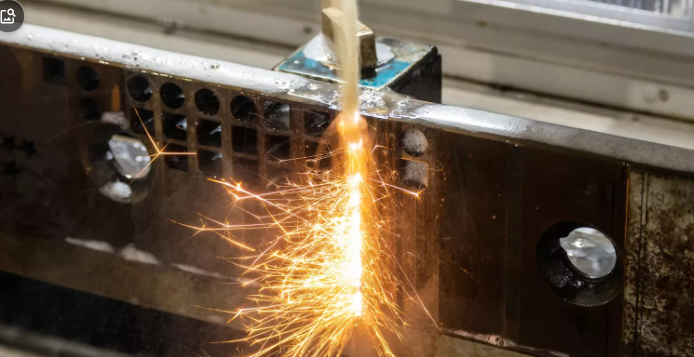
When you are seeking solutions in the field of precision manufacturing,you will always encounter a key decision point:which process is best suited for your non-standard parts?In many cases,wire cutting can become an extremely attractive option.Today,let's delve into the precision limits of wire cutting and explore exactly which unique non-standard parts it excels at processing.
Understanding the Precision Limits of Wire Cutting
First,we must recognize that no manufacturing process is a one-size-fits-all solution.Wire cutting,essentially,is a process of cutting metal through electro-discharge erosion.A very thin metal wire,acting as an electrode,moves along a predetermined path under precise computer control,thereby cutting the workpiece into the desired shape.
So,where are its precision limits?Modern high-precision slow-wire cutting machines can achieve astonishing dimensional tolerances of±0.001 millimeters and surface roughness levels of Ra 0.2 micrometers.This is almost an ideal choice for dealing with the vast majority of stringent tolerance requirements.However,this"limit"is not just a number.It also manifests in the ability to handle complex geometric shapes—it can easily process sharp corners,small internal fillets,and extremely complex contours that traditional CNC milling or CNC turning would struggle to reach.
However,wire cutting also has its boundaries.It is mainly used for through-hole cutting and is less effective for blind holes or complex three-dimensional structures,in which case we need to return to CNC milling or combined machining.
Which Non-Standard Parts Are Ideal for Wire Cutting?
Understanding the limits of wire cutting,let's look at its shining applications in real production.The following types of non-standard parts are particularly suitable for wire cutting technology:
• High-Precision Molds and Punches:This is the most classic application area for wire cutting.Whether it is plastic injection molds or stamping molds,their cavities,inserts,and ejector pins usually require extremely high hardness and extremely complex contours.Tool steel,after heat treatment,is extremely hard,and traditional cutting tools find it very difficult and costly to process.Wire cutting,however,"ignores"material hardness and can directly cut quenched steel,perfectly forming sharp edges and fine details,avoiding the precision loss caused by subsequent heat treatment deformation.
• Micro and Complex Geometric Parts:When your design involves extremely small gears,precision components in medical devices,or any parts with fine teeth and irregular holes,the advantages of wire cutting are unparalleled.It can achieve finer cutting than most CNC milling cutters,ensuring that even features at the micron level are accurately and correctly replicated.
• Prototypes and Trial Parts:In the product development phase,you may need a small number of functional verification pieces.These parts are often made of special materials or have complex structures.Using wire cutting,there is no need to make expensive dedicated molds;high-precision prototypes can be directly obtained from a sheet of material.This flexibility and rapid response capability make it a powerful tool for accelerating innovation.
• Expert in Cutting Hard Materials:Does your project involve super-hard alloys such as tungsten steel or high-speed steel?Conventional CNC machining,when faced with these"stubborn"materials,experiences rapid tool wear and a dramatic increase in costs.Wire cutting,however,can handle these challenges with ease,providing stable,high-quality cutting on these hard materials.
Synergy of Wire Cutting with Other Precision Manufacturing
Wise manufacturers know how to combine different processes effectively.In the manufacturing of a single part,CNC turning might first be used to create the cylindrical base,followed by CNC milling to carve out the main three-dimensional features,and finally,wire cutting is employed to refine the most critical and complex internal holes.This collaborative approach is the cornerstone for modern smart factories to achieve high efficiency,low cost,and high-quality goals.
In summary,wire cutting is not intended to replace CNC milling or CNC turning but rather to complement their capabilities powerfully.When your non-standard parts face challenges such as high-hardness materials,extremely complex two-dimensional contours,stringent tolerance requirements,or microstructures,wire cutting technology is likely the precise key to unlock your success.It is hoped that this analysis will help you make wiser process choices in your next project.