






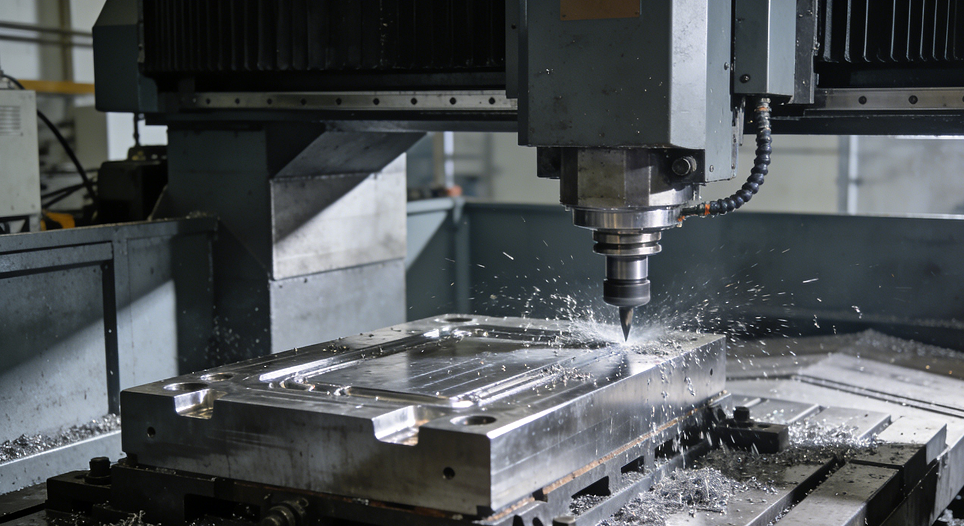
In precision manufacturing, gantry-type CNC machining centers have become indispensable solutions for processing large critical components due to their exceptional rigidity and extensive machining range. Particularly during the initial roughing stage of large castings and forgings, achieving efficient material removal while maintaining stability and precision serves as a crucial indicator of a company's production capability. The following Q&A series delves into the core technologies and application strategies of gantry CNC in this field.
Question: What is the primary advantage of gantry CNC machining centers when facing rough machining of large workpiece blanks?
Answer: The essential advantage of gantry structures lies in their extraordinary rigidity. Compared to other configurations, gantry frames excel at resisting the substantial overturning moments and cutting forces generated during machining, providing a solid mechanical foundation for heavy duty cutting. This rigidity directly translates into process stability, allowing the equipment to maintain high precision guideway motion while enabling high power spindles for deep cutting and high feed rate machining. Consequently, blanks can be rapidly and efficiently machined to near- net shapes, representing the first step toward achieving efficient material removal.
Question: How can the full machining potential of gantry CNC be realized during heavy duty cutting?
Answer: The key lies in the synergy between the power system and torque characteristics. Gantry CNC specifically designed for heavy-duty machining typically feature high power, high torque spindles. High torque characteristics ensure that even during large depth cutting at low rotational speeds, the spindle can provide sufficient rotational force to prevent tool stoppage or damage due to excessive resistance. This is particularly suitable for processing castings and forgings with uneven material properties and large allowances, enabling tools to smoothly and continuously remove large volumes of metal and transforming the equipment's design potential into actual productivity.
Question: What role does the tool system play in powerful machining, and how should it be selected?
Answer: The tool system serves as the direct bridge connecting machine tool power to workpiece material, making its selection critically important. In powerful roughing operations, high rigidity, high precision clamping toolholders should be selected first. These toolholders typically employ large tapers or specific clamping designs to ensure that the connection between tool and spindle remains stable and reliable under tremendous cutting forces, eliminating micro movements and vibrations, which is the prerequisite for ensuring machining quality and tool life. Secondly, tool selection itself must balance material properties, geometric angles, and coating technologies. For different cast and forged materials, tough, impact resistant specialized roughing inserts should be chosen. Their unique groove designs facilitate smooth evacuation of large chips and reduce cutting heat, thereby achieving continuous, efficient material removal.
Question: How should a comprehensive process strategy for rough machining of large workpieces be constructed?
Answer: Successful process strategies result from systematic thinking. They begin with comprehensive analysis of workpiece material characteristics, machining allowances, and final precision requirements. Based on this, matching machine tool power and torque parameters are selected, step-by-step cutting paths are established, and depth and width for each pass are reasonably allocated. Combined with specialized high-efficiency roughing tools and appropriate cooling and chip evacuation solutions to control workpiece thermal deformation and maintain stable machining environments. The entire process emphasizes not merely single-point powerful cutting, but the smoothness and reliability of the entire process chain, ensuring the transformation from blank to semi-finished product is both rapid and leaves ideal allowance and surface conditions for subsequent finishing operations.
Question: How does gantry CNC machining technology contribute to the final product's precision?
Answer: Precision often begins with a solid foundation. The powerful roughing capability of gantry CNC is not merely about material removal; its core value lies in establishing a workpiece foundation with highly controllable geometry and stress states for subsequent operations. Through efficient, stable, and controlled heavy cutting, internal residual stresses in blanks can be rapidly eliminated, forming dimensionally stable semi-finished products with uniform allowances. This significantly reduces the adjustment burden and uncertainty in subsequent finishing stages, making the ultimate achievement of micrometer-level or higher precision more efficient and reliable. Therefore, gantry machining technology embodies a precision assurance capability that spans the entire machining cycle.
On the path exploring the limits of precision manufacturing, solid foundational machining capabilities serve as the cornerstone of technological advancement. By deepening understanding and application of gantry CNC heavy-duty machining technology, we are committed to transforming raw materials into industrial components with exceptional precision and reliability.
For more detailed information about precision manufacturing and engineering capabilities, please visit our official website www.simituo.com.