






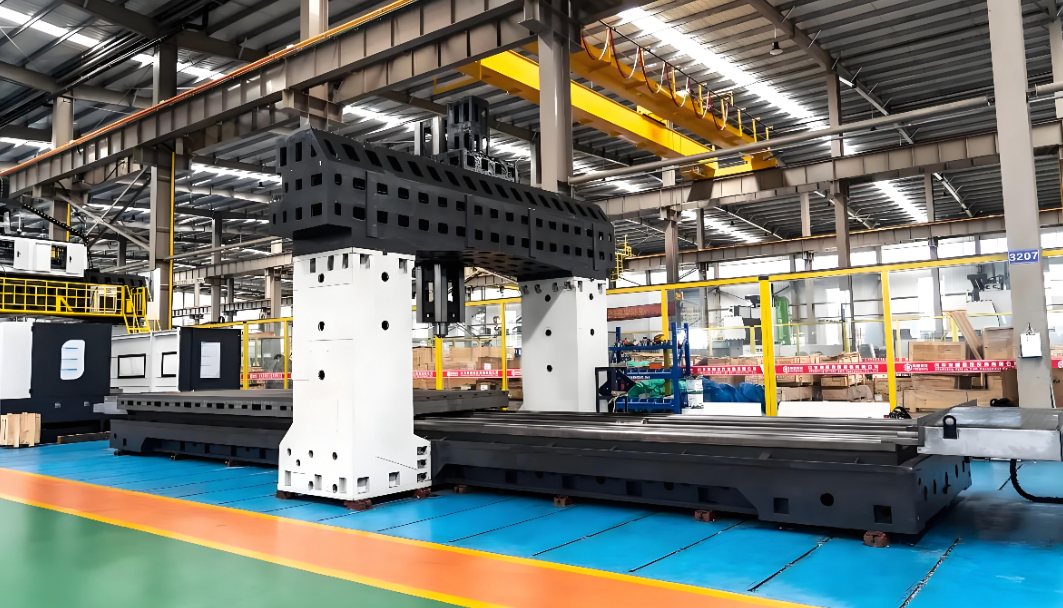
In today’s highly automated manufacturing world, choosing the right machine tool is a non negotiable step toward competitive advantage. When parts are large, heavy, or sculpted with complex surfaces, producers need a solution that combines high rigidity, wide travel, and long term stability. CNC gantry machining meets these demands better than any other platform.
Its portal frame: two rigid columns and a cross beam form a closed “gate.” This architecture delivers exceptional natural stiffness, damping vibration during heavy cuts and laying the groundwork for micron-level accuracy.
Precision is treated as a system. Ground-class linear guides and ball screws set the motion baseline, while an intelligent control loop applies real-time compensation for thermal drift and cutting-force deflection. The result is repeatable, micron-grade performance anywhere on the table.
By integrating simultaneous five-axis heads. The spindle can approach the work from any angle in a single setup, eliminating re-fixturing errors and slashing cycle time. Complex geometries are finished in one go, expanding the range of possible processes.
Long-term productivity and supply-chain security. A well built gantry is a production node that lasts decades, suffers minimal downtime, and accepts future module upgrades. It is a strategic asset that protects capacity and quality for years to come.
We deliver intelligent gantry solutions engineered for performance and reliability. Visit www.simituo.com for specifications and case studies.