






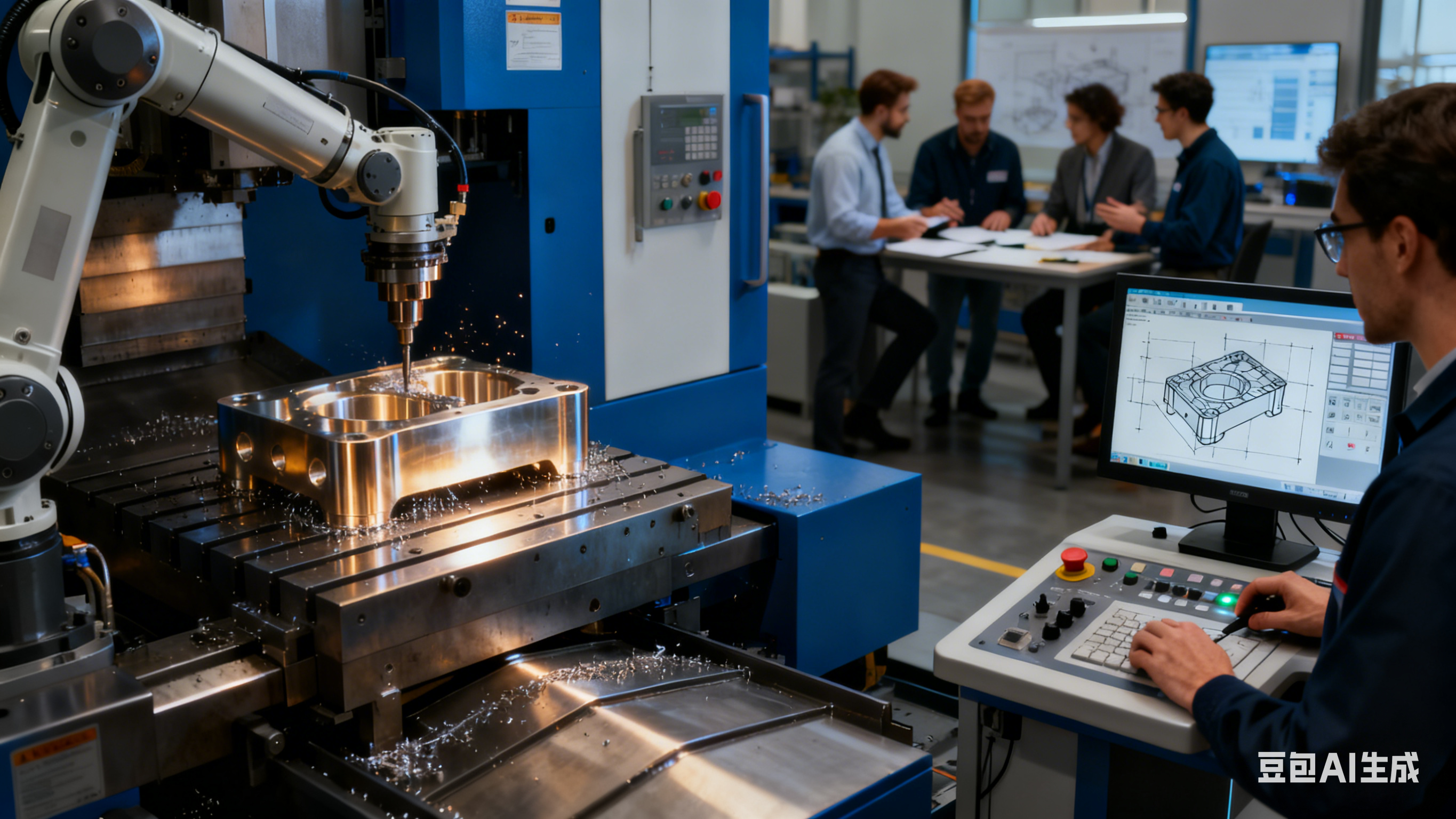
In the daily practice of precision manufacturing,we often encounter this challenge:how to improve production efficiency without significantly increasing operating costs while ensuring product quality?This is not only a question for managers to ponder but also a direction that every frontline engineer continuously explores.
Walk into any modern machine shop,and you will see CNC machining centers running steadily.Whether it is complex five-axis milling or intelligent lathes efficiently performing turning operations,these machines constitute the core of modern manufacturing.However,the advanced nature of the equipment itself is just the foundation.What truly determines efficiency and cost are often those seemingly insignificant process details.
Let's start with a common issue:when you are performing CNC milling,have you ever been troubled by frequent tool changes?In fact,by optimizing tool paths and cutting parameters,many factories have improved production efficiency by more than 15%without any additional investment.This does not require profound theory,but rather a careful analysis and adjustment of the machining program.For example,appropriately increasing the feed rate in certain non-critical areas and reducing idle travel time while ensuring precision requirements can accumulate into significant time benefits.
In CNC turning operations,another often-overlooked aspect is the setup of workholding fixtures.Suitable fixtures can not only reduce workpiece clamping time but also significantly lower the defect rate.We have witnessed a partner who,by redesigning the fixture system,reduced the average clamping time for a single part from three minutes to forty seconds.Moreover,due to more precise positioning,the consistency and stability of the products were also significantly improved.
For the manufacturing of parts with extremely high precision requirements,quality control in the precision machining process is especially critical.Traditionally,many factories rely on final inspection to screen out qualified products,which is not only inefficient but also unable to guide the production process in real-time.A more effective method is to move quality control forward—by setting up online measurement points at key processes to provide timely feedback on machining deviations and automatic compensation.Although this preventive quality control strategy requires a small initial investment,in the long run,it avoids a large amount of rework and scrap losses,effectively reducing overall costs.
When integrating the entire production process,digital tools offer a new perspective.By collecting and analyzing machine tool operation data,manufacturers can identify bottlenecks in the production process.For example,some factories found that their actual cutting time for CNC machines only accounted for 30%of the total operating time,with a large amount of time consumed in preparation.In response to this finding,they successfully doubled the machine utilization rate by standardizing setup procedures,pre-adjusting tools,and optimizing material flow.
The key to implementing these optimization measures lies in a culture of continuous improvement.The best practices often come from the experience accumulation of frontline operators.Regularly organizing technical personnel sharing sessions and encouraging them to propose improvement suggestions can often yield many simple and practical innovations.This wisdom from actual production usually solves long-standing efficiency problems at the smallest cost.
Modern manufacturing has long surpassed the stage of simply competing on the advancedness of equipment.The real competitiveness lies in the continuous optimization of the production process.Whether it is a small machine shop or a large manufacturing enterprise,by systematically analyzing and improving each production link,it is possible to achieve dual improvements in quality and efficiency without significantly increasing investment.In this process of continuous improvement,every small improvement is a solid step towards a higher level of manufacturing.