






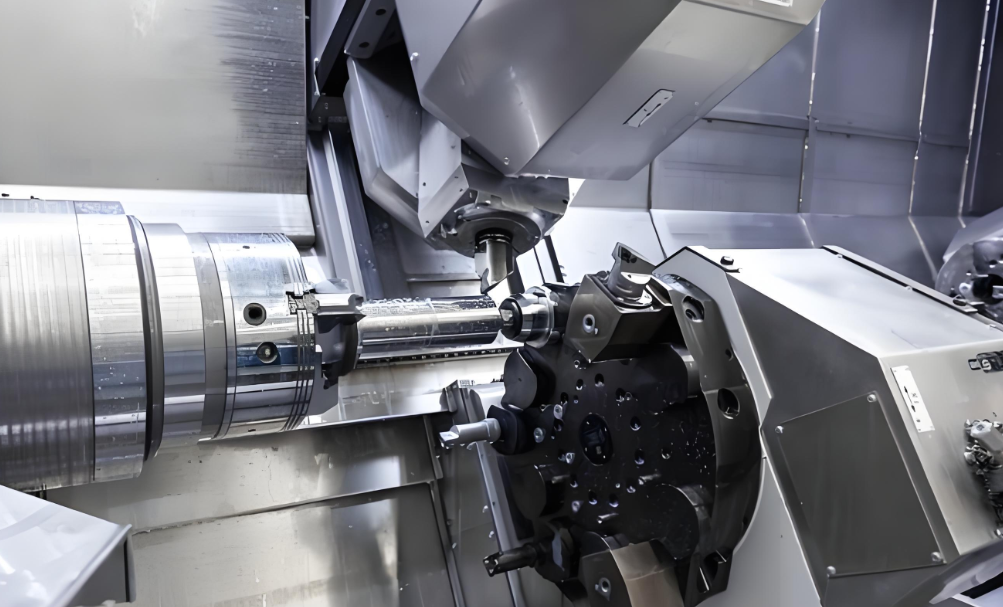
Q1: How is gantry CNC rewriting the rules of precision manufacturing?
A1: Think of a bridge made of solid cast iron that just happens to hold a spindle. That “bridge” soaks up chatter before you even hear it, letting us park the cutter within microns on a sculpture-like turbine panel or an engine rail as long as a pickup truck. Designers notice the side effect: ribs, spirals and undercuts they once left on the sketch pad now ship as real metal. We bolt smart tool-path code and live sensors onto the frame, so idea, prototype and finished part often share the same afternoon.
Q2: Where does the gantry layout score when the job is nasty?
A2: Rigidity is only half the story. The beam stretches across both columns, so heat and cutting loads cancel themselves out; the spindle keeps pointing true while it chews through Inconel or a pocket that looks like a Möbius strip. Five faces are milled in one clamping, killing queue time, and a 20 000 rpm spindle with chilled flood coolant leaves Ra 0.2 µm finishes without a second operation.
Q3: How do you police quality on a machine that big?
A3: We litter the work zone with temperature, load and vibration nodes that phone home every millisecond. A cloud engine compares real numbers with the digital twin; if the model drifts, the feed slows or the tool gets swapped before the part knows anything is wrong. Calibrations are locked to a metrology-grade granite square every swing shift, and a laser tracker spot-checks features while the chips are still warm.
Q4: Custom part, low volume – can you still play?
A4: The only thing we change faster than fixtures is code. A tweak in the post-processor lets us hop from aluminum to titanium, from a fist-sized optical bracket to a 3 m weld-mold, in the time it takes to grab a coffee. Engineers sit elbow-to-elbow with the customer on the shop floor, carving prototypes out of wax or Ti-6-4 until the geometry, cost and lead-time boxes are all ticked.
Q5: Batch work – how do you keep the last piece identical to the first?
A5: Once the cut file is blessed, tool-life software counts every revolution; when predicted wear hits 80 %, a sister tool is pre-staged. Bar-code blanks, automated probing and adaptive feed override hide normal tool decay, so part #1 and part #1000 share the same Cpk. Lights-out shifts run 22 hours; the remaining two hours are for a quick ball-bar health check and a coffee refill.
Q6: Markets shift overnight – how do you stay ahead?
A6: We feed historical cutting data to an AI that spots trouble before the human eye can: bearing fatigue, coolant decay, even supplier batch changes. Cloud dashboards let the customer watch the spindle utilisation the same way they track Uber arrivals. When a new alloy or tighter spec drops, we simulate it at 2 a.m., push the revised parameters at 6 a.m., and cut good parts by breakfast.
Q7: What keeps the platform reliable for the long haul?
A7: We over-spec linear rails, use grease that costs more per litre than good wine, and swap filters on a calendar, not on pressure drop. Annual retrofits add new sensors or a fresher CNC kernel, so a five-year-old gantry often outruns the day-one spec. Training credits are baked into every purchase; operators leave knowing how to coax twenty-year life out of a spindle that’s already faster than yesterday’s model.
Want the long read? Full specs and case files wait at www.simituo.com.